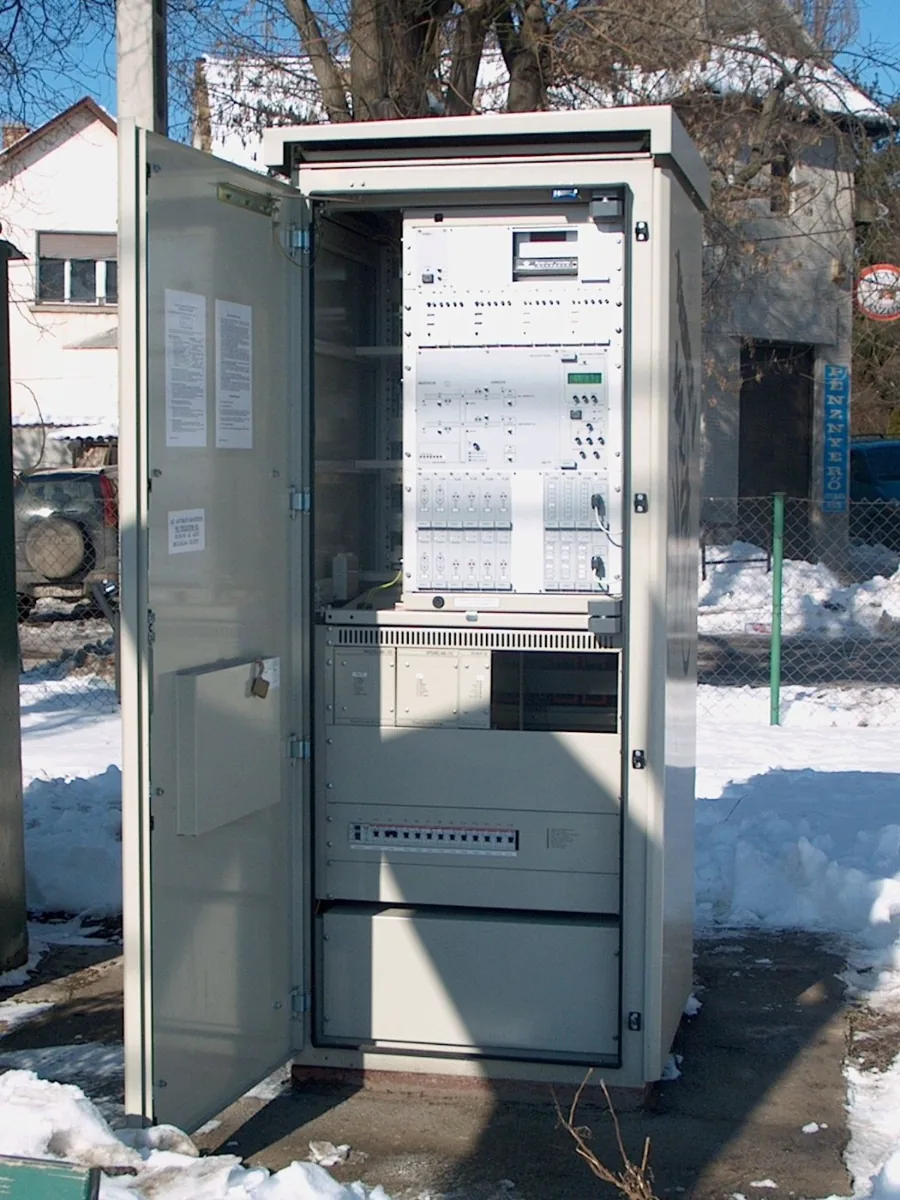
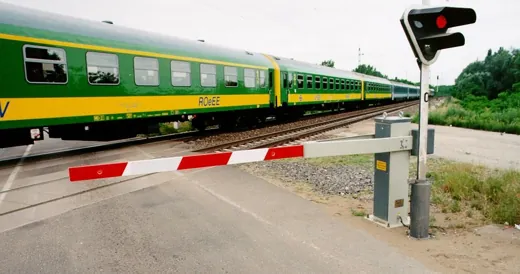
The UTB equipment of Műszer Automatika Ltd. is the first fully electronic railway signalling system developed in Hungary. Its development started in 1994 with the support of the National Committee for Technological Development (OMFB). Holding all the necessary approvals and certificates, the prototype entered service in December 2000. Since then new installations have been handed over continuously; 15 units are now in operation in Hungary, and since 2008 two level crossings protected by UTB have also been operating abroad. The control of the UTB is fully electronic, with two microprocessors. Apart from the relays that perform the safety switch-off, it contains no relays at all.
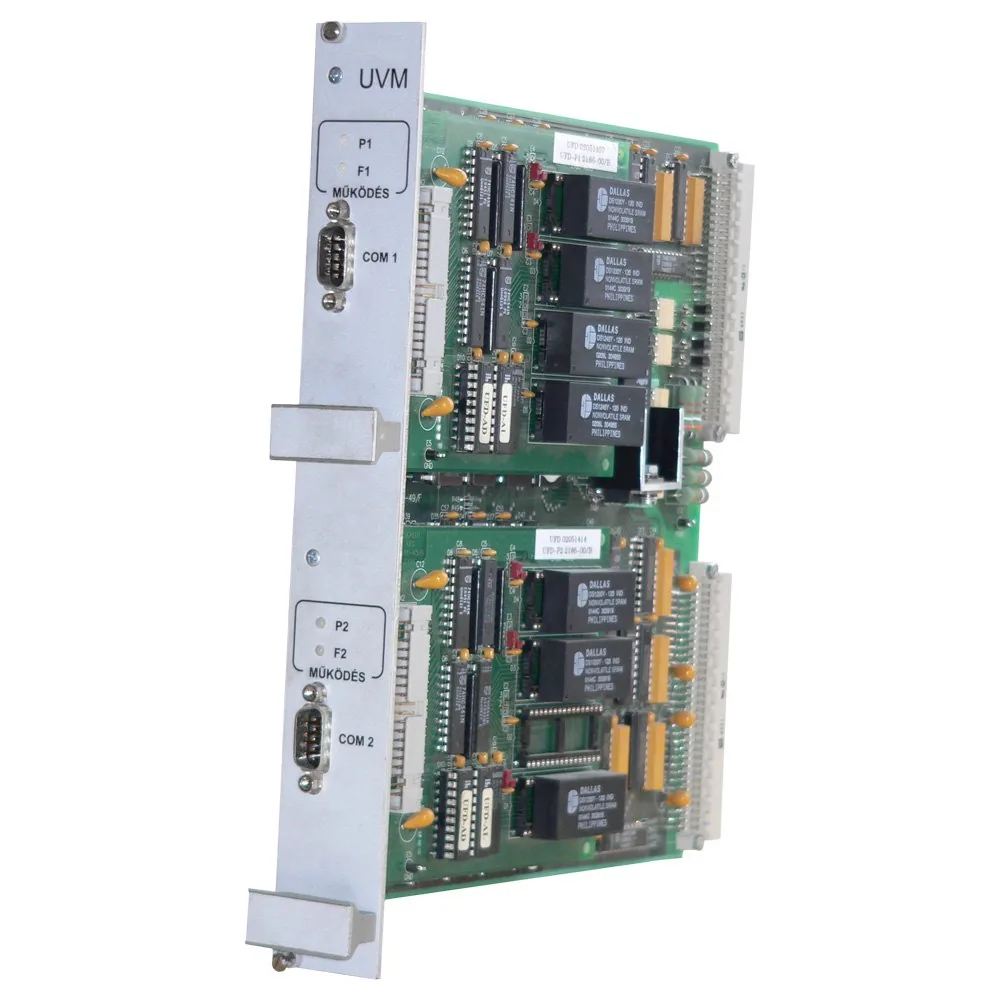
Thanks to its modular hardware, it is easy to adapt to local requirements and can be extended later. In a given railway environment every UTB runs the same software, matching the rules of the operating railway. Because the software is layered, the certified software that implements the safety functions is based on the rules of the railway operating the level crossing, not on individual sites. The equipment is adapted to the local layout by setting a parameter table in the next layer – so for new installations, or when the protection of an existing level crossing changes, the certified software can handle the new elements and sites.
Accordingly, during its service life the UTB can be extended – regardless of its earlier configuration – with further road signals, railway signals if required, and barrier booms.
A level crossing protected by UTB can have light signals only or light signals and half barriers, and the UTB can also work together with road traffic control equipment. In its current configuration it can protect up to three tracks. Train detection can use point detection, long track circuits or axle counter sections, and the UTB can also accept a start command from other equipment. If required, a level crossing indicator signal or a protecting signal can be installed, or the UTB can be interlocked with a signal controlled by another interlocking.
Operation and maintenance are supported by a diagnostic and remote monitoring system; the latter allows continuous monitoring of the UTB over a wired or wireless connection. Remote control can be connected to any indication system used on the Hungarian railways, including the so-called two-wire indication used on the national railways. The remote control interface also allows the equipment to communicate directly with other interlockings in the form of electronic telegrams. The UTB's own remote control panel can also be installed at the traffic control point receiving the indications, even built into the Domino panels widely used in Hungary.
With the remote monitoring system, much deeper diagnostics are possible than the data shown on the remote control panel: the automatic tests of the equipment, the fault log and an exact log of the events generated by train movements can all be retrieved. The equipment also has a so-called "black box" that records its states precisely with time stamps, so it can be used in investigations following incidents that require official proceedings. The black boxes can be removed and replaced on site after shutting down the equipment, so the equipment can continue operating without overwriting the data needed for the investigation. The modular design also pays off in operation: standardised components that are interchangeable between installations are easy to replace, and spare parts are more economical to stock.
Modularity also supports the extensibility mentioned above, so the equipment can be adapted to changing traffic needs during its service life.
Since the prototype entered service, the UTB installations in Hungary have completed nearly 2.5 million operating cycles and earned the recognition of the operators. This number of cycles has also provided enough operating experience for continuous development: during some 133,000 operations examined, only 410 disturbances occurred, mostly due to external causes. On request, the operation of the equipment is supported by the nationwide service network of Műszer Automatika Ltd. If ordered by the operator, we carry out periodic maintenance and can also provide support in the event of disturbances or failures.
Current configuration of the UTB
- 3 railway tracks (expandable)
- point, long-section or axle counter train detection
- railway protecting signals per track and direction, as specified by the customer
- optional repeater signal for any railway protecting signal
- 16 road signals (expandable)
- 8 barrier machines (expandable)
- LED or bulb lamp circuits (35 V, 330–475 mA)
- interface to road traffic controllers
- electronic remote control interface – remote monitoring with several data transmission options (IP, GSM/GPRS, telephone)
Advantages of the UTB
- Compact, modular design
- Railway-specific, certified, layered software
- Each level crossing is configured from a parameter table
- Few wearing parts
- Low failure rate
- Low maintenance requirements
- Detailed fault and operating logs
- Full technical remote monitoring with several data transmission options
- Nationwide service network
References
- 15 units in Hungary
- 2 units in Bosnia and Herzegovina